
How to Practice Smarter, Not Harder
Every guitarist has felt it at some point: you sit down to practice for an hour, but when you stand up, you don’t feel any better than when you started. It’s frustrating. You’re putting in the time, but the results aren’t showing up. The truth is, progress isn’t just about how much you practice—it’s about how you practice.
At On Track Music, we believe learning the guitar should be a journey you enjoy for a lifetime. That means ditching the mindless noodling and replacing it with focused, effective strategies. Here is your guide to practicing smarter, not harder, so you can see real growth every time you pick up your instrument.
Set Specific, Achievable Goals
The biggest enemy of progress is aimlessness. Sitting down with the vague idea to “get better” usually results in playing songs you already know. To practice smarter, you need a roadmap.
The Micro-Goal Method
Instead of setting a huge goal like “learn a Van Halen solo,” break it down into micro-goals for each session.
- Bad Goal: “I’m going to learn this whole song today.”
- Smart Goal: “I’m going to master the first four bars of the verse at 60 BPM.”
When you achieve a small goal, your brain releases dopamine. This keeps you motivated and eager to tackle the next small chunk. Over a week, these small chunks add up to massive progress.
Quality Over Quantity: The 20-Minute Rule
There is a misconception that you need to practice for four hours a day to get good. While professional musicians might do that, most students don’t have that luxury—and they don’t need it.
Focus requires energy. The human brain can only maintain deep focus for about 20 to 30 minutes before it starts to drift. A focused 20-minute session where you are fully engaged is infinitely more valuable than an hour of distracted playing while watching TV.
Try this routine:
- 5 Minutes: Warm-up (scales, spider exercises).
- 10 Minutes: Deep work on one specific challenge (a new chord change, a difficult riff).
- 5 Minutes: Fun playing (jamming, improvising, or playing a song you love).
Isolate the Problem Areas
It is human nature to play the parts of a song we are good at and gloss over the parts we struggle with. If you stumble on a specific measure but keep playing through the whole song, you are essentially practicing the mistake.
The “Looping” Strategy:
Identify the exact spot where your fingers get tied up. It might just be two notes or one chord transition. Isolate that tiny section and loop it. Play it slowly and perfectly ten times in a row. Don’t move on until you can play it without thinking. By fixing the weak link, the whole chain becomes stronger.
Use a Metronome (Your New Best Friend)
Rhythm is the most important element of music. You can play all the right notes, but if they are out of time, it won’t sound like music.
Using a metronome forces you to be honest about your timing. It prevents you from rushing easy parts and dragging through hard ones. Start slow—painfully slow if necessary. If you can’t play it slow, you can’t play it fast. Once you lock in the groove at a slow tempo, gradually increase the speed. You will be amazed at how much tighter your playing becomes.
The Mindset Shift: embrace the Struggle
Learning guitar is not a straight line; it’s a series of plateaus and breakthroughs. Sometimes, it feels like you are stuck. This is actually a good sign. It means your brain is processing new information.
When you feel frustration rising, take a breath. Remind yourself that the struggle is the feeling of learning happening. Be kind to yourself. No one sounds like a rock star in their first month (or even their first year!).
Mental Practice Tips:
- Visualize: Even when you aren’t holding the guitar, visualize your fingers moving on the fretboard. Studies show mental practice can be surprisingly effective.
- Listen Actively: Listen to the songs you are learning. Pay attention to the nuances—the dynamics, the tone, the vibrato. Absorbing the music mentally helps you reproduce it physically.
Track Your Progress
It’s easy to forget how far you’ve come. Keep a simple practice journal. Write down what you worked on, the tempo (BPM) you reached, and what you want to tackle tomorrow. Looking back at a journal from three months ago and seeing that you struggled with something that is now easy is a huge confidence booster.
Get the Right Support
Self-teaching can only take you so far. Sometimes, practicing smarter means asking for help. A structured program with experienced instructors can save you years of trial and error by correcting bad habits before they stick.
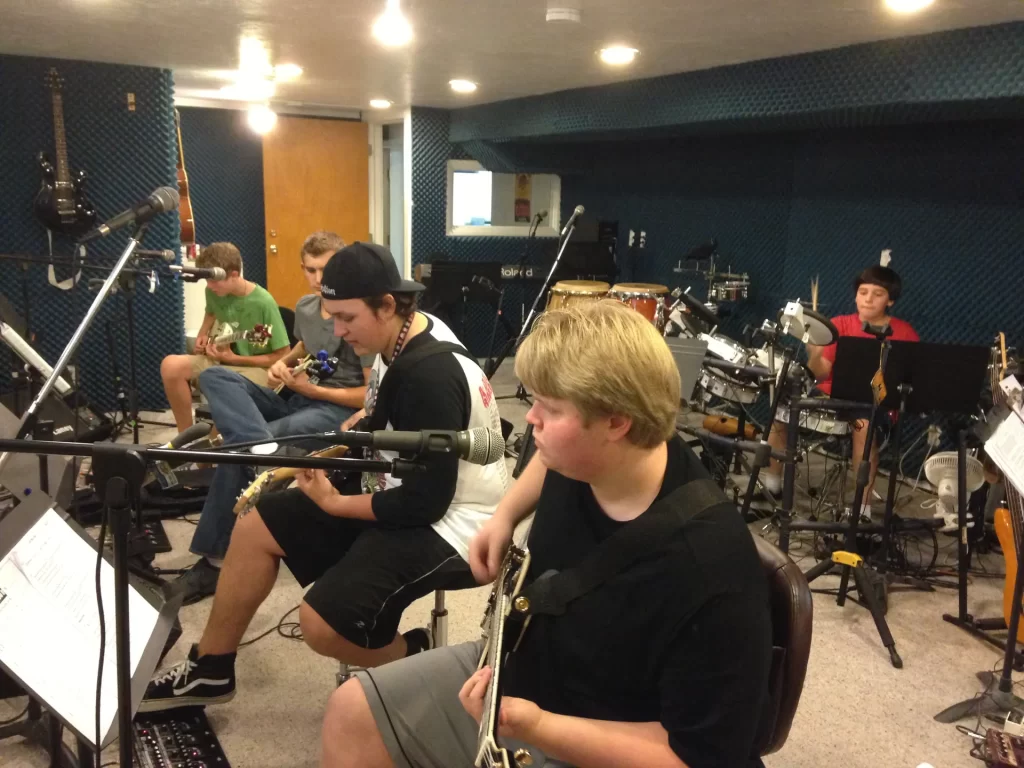
At On Track Music Guitar School, we specialize in the “Right Way” to learn. Whether through private lessons or our famous AMPD Student Rock Bands, we provide the structure, motivation, and community you need to thrive.
Ready to accelerate your progress? Stop guessing and start growing. Check out our guitar lessons and programs today and let’s get your playing on track!