
From Bedroom Guitarist to Live Performer: What Students Learn the First Time They Take the Stage
There’s a big difference between playing guitar alone in your bedroom and stepping onto a stage with an audience watching.
At home, you can stop when you make a mistake. You can restart the song. You can slow down the difficult section or try it again tomorrow.
On stage, the music keeps going.
And that’s exactly what makes performing such a valuable part of becoming a musician.
At On Track Music Guitar School, students have opportunities to take what they’ve learned in lessons and experience music in an entirely different way: by performing it.
That first performance can be intimidating, exciting, challenging, and unforgettable—and students often walk away having learned far more than a song.
Practice Feels Different When There’s a Performance Ahead
When students are practicing without a specific goal, it’s easy to say, “I’ll work on that tomorrow.”
A performance date creates a deadline.
Suddenly, students have a reason to polish the difficult section, memorize the arrangement, improve their timing, and practice the entire song from beginning to end.
They’re no longer practicing just to get better someday.
They’re preparing for something.
That shift can dramatically change a student’s focus and motivation.
Students Learn How to Manage Nerves
Almost everyone gets nervous before performing.
The goal isn’t necessarily to eliminate those nerves. It’s learning how to perform despite them.
Students begin discovering how to:
- Prepare thoroughly
- Stay focused
- Control nervous energy
- Trust their practice
- Keep playing under pressure
Then something exciting happens.
The performance ends.
They did it.
That experience gives students proof that they can do difficult things even when they’re nervous—a lesson that reaches far beyond music.
You Learn That Mistakes Aren’t Disasters
One of the most important lessons students learn on stage is that mistakes happen.
A guitarist might miss a note.
Someone may enter a section early.
A singer might forget a lyric.
But the song doesn’t have to stop.
Experienced musicians learn to recover and keep playing.
That ability to adapt is one of the biggest differences between practicing music and performing music.
Students learn that perfection isn’t the goal. The goal is to stay present, listen, recover, and keep the music moving.
Performing Teaches Students to Listen
When playing alone, it’s easy to focus entirely on your own instrument.
Playing with a band requires something more.
Students have to listen.
They begin paying attention to:
- The drummer’s tempo
- The bass player’s groove
- Vocal cues
- Song transitions
- Dynamics
- Other guitar parts
Instead of thinking only about “my part,” students begin understanding how their part fits into the entire song.
That’s a major step toward becoming a complete musician.
Stage Confidence Is Built Through Experience
Confidence isn’t something students have to possess before performing.
It’s something they can develop by performing.
The first performance may feel intimidating.
The second usually feels a little easier.
After several performances, students begin learning how to walk onto a stage, set up, communicate with other musicians, recover from mistakes, and connect with an audience.
Eventually, the stage begins to feel familiar.
That confidence is earned through experience.
Performing Makes Music Feel Real
There is something powerful about hearing applause after spending weeks learning a song.
For students, it connects effort with accomplishment.
All of those practice sessions suddenly have a purpose.
The chord that was difficult three months ago is now part of a song they’re performing in front of an audience.
That experience can completely change how students think about practice.
They’re no longer simply taking guitar lessons.
They’re becoming musicians.
Playing in a Band Adds Another Level
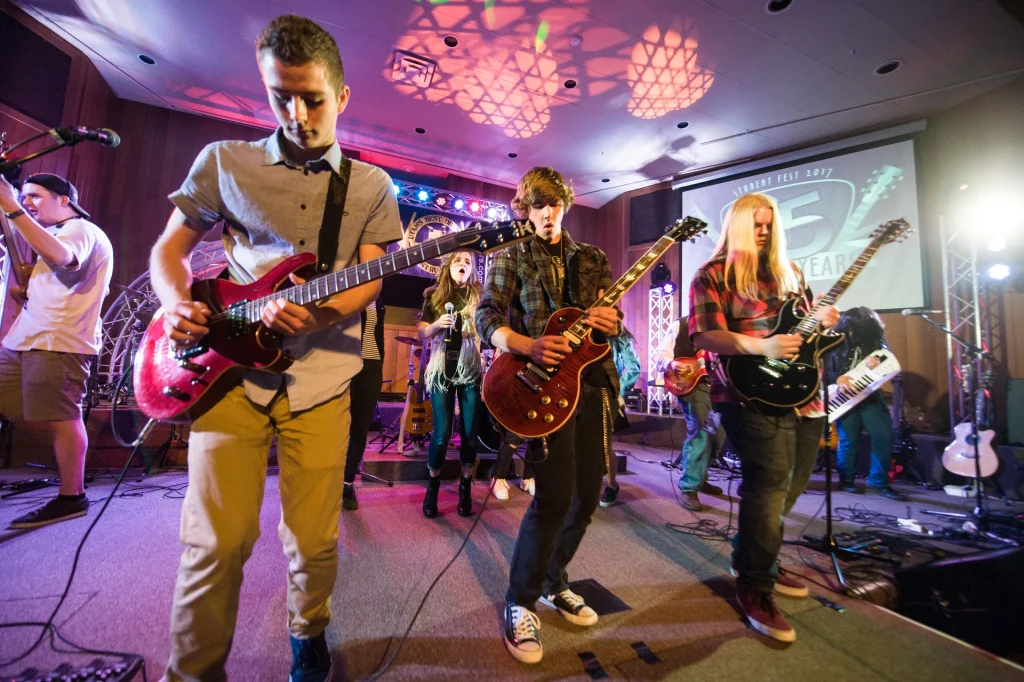
For students participating in On Track Music’s AMPD Student Rock Band Program, performance becomes even more collaborative.
AMPD students rehearse in a real band format with musicians such as guitarists, bass players, vocalists, drummers, and keyboard players.
They learn how to prepare songs together, interact musically, and work toward a successful performance as a group.
They also discover an important lesson:
Everyone matters.
If one musician isn’t prepared, the entire band feels it. That creates accountability while teaching teamwork and responsibility.
On Track Students Get Real Opportunities to Perform
On Track Music Guitar School doesn’t treat performance as an afterthought.
Students have access to multiple public performance opportunities throughout the year.
Events such as Student Fest, Summer Jam, and Winter Expo give students a chance to take what they’ve learned out of the lesson room and onto the stage.
Student Fest includes individual and group performances as well as AMPD Band concerts, while Summer Jam and Winter Expo provide additional opportunities for student bands to perform.
These aren’t imaginary performance exercises.
Students get the experience of preparing for and participating in real musical events.
The Moment After the First Performance
Ask a student how they feel immediately before their first performance and you may hear:
“Nervous.”
Ask them again after they walk off stage and the answer is often completely different.
“Can I do that again?”
That transformation is one of the most exciting parts of music education.
Students discover that the thing they were afraid of can become the thing they love.
Final Thoughts
Learning guitar begins with chords, scales, rhythm, and technique.
Becoming a musician requires something more.
Performance teaches students how to prepare, listen, adapt, collaborate, manage pressure, and trust themselves.
At On Track Music Guitar School, students have opportunities to move beyond practicing songs and experience what it actually feels like to perform them.
Because there’s a special moment when a student steps onto a stage for the first time.
They may walk up as someone who’s learning guitar.
But they walk off feeling like a musician.